
The Unseen Advantage: Mastering the Inner Game of Your 2026 Climate Job Search
Why even the most qualified professionals doubt their climate relevance—and how to make progress.
You have the track record. You have the discipline. You’ve likely spent years solving complex problems in high-stakes environments.
But as you look toward a climate transition in 2026, you might find yourself hitting an invisible wall. You open your inbox to another "decision to move in a different direction," or you scroll past a peer’s "I’m happy to share" LinkedIn post, and a quiet, persistent thought surfaces:
“Maybe my experience just doesn’t translate to this world.”
After coaching dozens of mid-to-senior professionals through this pivot, I’ve noticed a consistent, frustrating irony:
The more competent and "climate-ready" someone is, the more they tend to doubt themselves.
I coached a PhD physicist who worked in a Department of Energy lab who questioned if she had anything to contribute to solving climate change. I’ve worked with a Director of Analytics at a Fortune 10 company who hesitated to apply for senior climate roles because his data science expertise "wasn’t the right kind."
In both cases, the barrier wasn’t their resume. It was a specific set of limiting beliefs that dictated which roles they targeted, how they networked, and how they showed up in interviews.
If you’re feeling this way, know that your thoughts are not a neutral observation. They are the story you tell yourself that can make minor setbacks feel like catrastrophes. And they might be exactly what is slowing down your climate transition.
This article isn’t about fixing your resume or finding your niche. It’s about mastering the invisible layer of your search, and using the ROOTS™ Method to turn your inner doubts into your greatest competitive advantage.
Author’s Note: This article is a deep dive into the Audit phase of the A.S.S.E.T. Method™, my five-part framework for transitioning into climate work. While most job seekers start with their resume, we start here: with the foundations that determine your success.
Why your beliefs matter
Your beliefs about your qualifications, relevance, and the climate job search are powerful. Whether you are aware of them or not, your beliefs and self-talk shape whether:
You’re brave enough to just take the first step, or too afraid to get started
You trust you can focus on 1 climate niche, or you think you can only spray-and-pray since you don’t have specific climate expertise anyway
You summon the courage to network and ask for help, or hide behind direct applications alone
You aim for the stretch role you’re genuinely interested in, or settle for the safer role
What many job seekers get wrong
Many climate jobseekers, even the more self-aware ones, make the same mistakes when their limiting beliefs are running in the background. They’ll:
Subconsciously keep their effort at 70% so rejection doesn’t sting as much
Avoid the scary step that could actually make a difference because it risks rejection (”what if take the risk, and I still don’t get the interview invite?”)
Treat one rejection, ghosted application, or awkward moment in a networking call as a verdict on whether they belong in climate at all
Here’s what to do instead
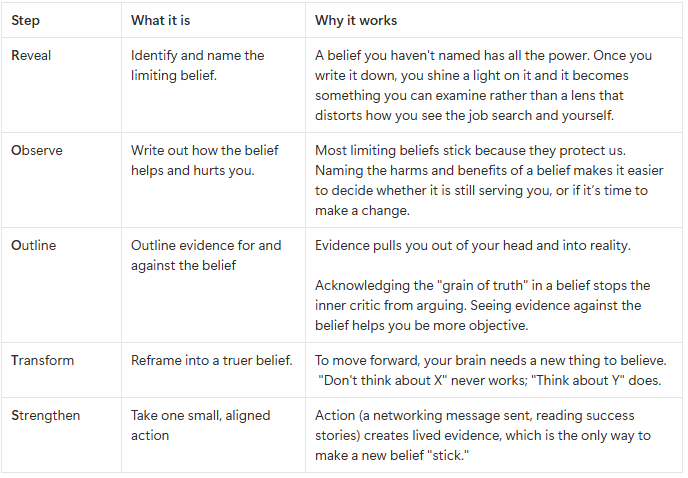
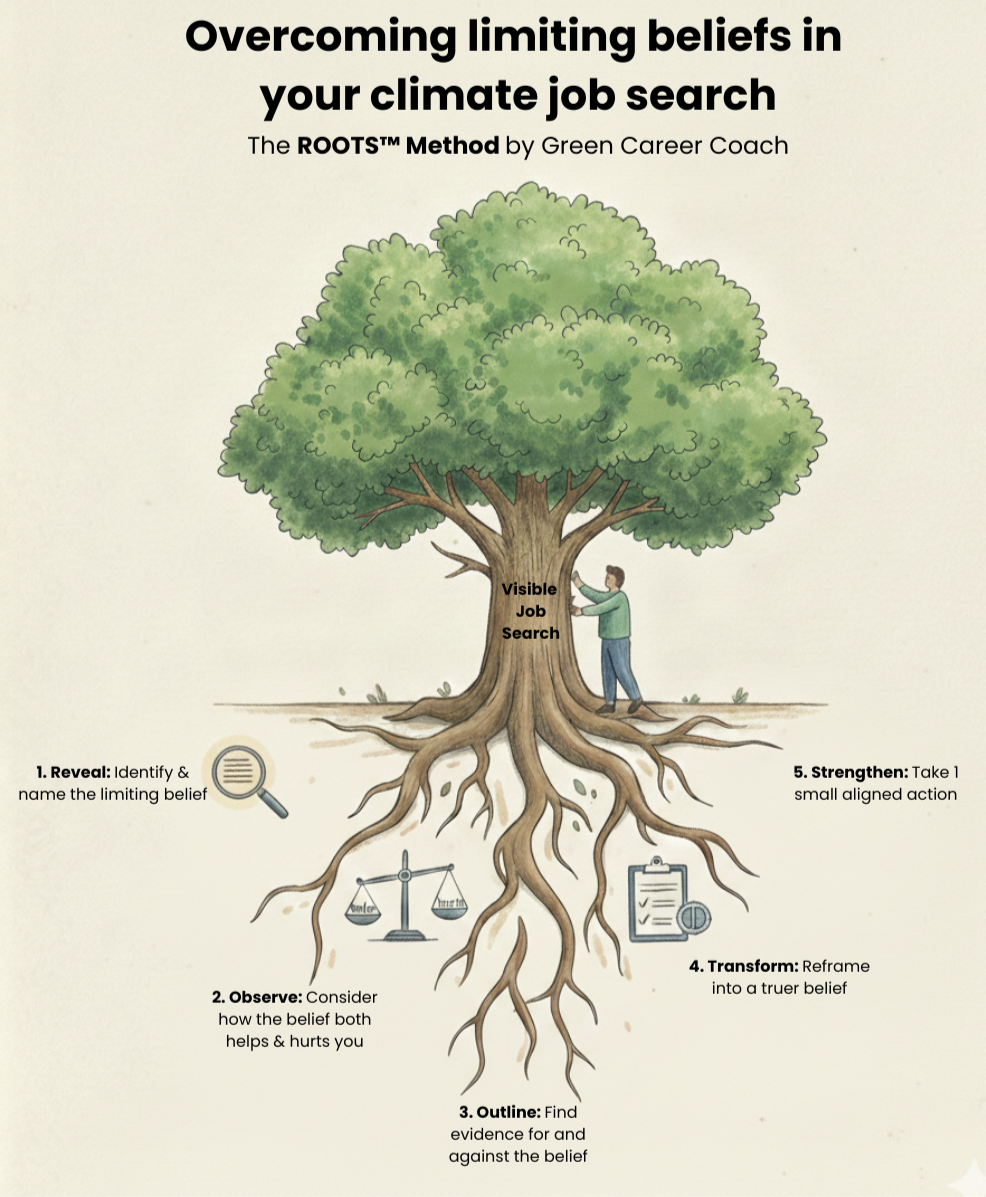
To identify and overcome the limiting beliefs that may be holding back your climate job search, we’re going to use the ROOTS™ Method.
Why ROOTS?
Because plants are amazing, and this is about climate change after all 🙂. Also, if your job search is the visible tree, your beliefs are the roots underground. You can do everything right on the surface, but if your roots are weak, your growth will stall. Strengthen the roots, and everything above ground flourishes too.
Applying the ROOTS™ Method to 3 common, limiting climate beliefs
Limiting belief #1: “I need a degree in climate, science, or engineering to work in climate”
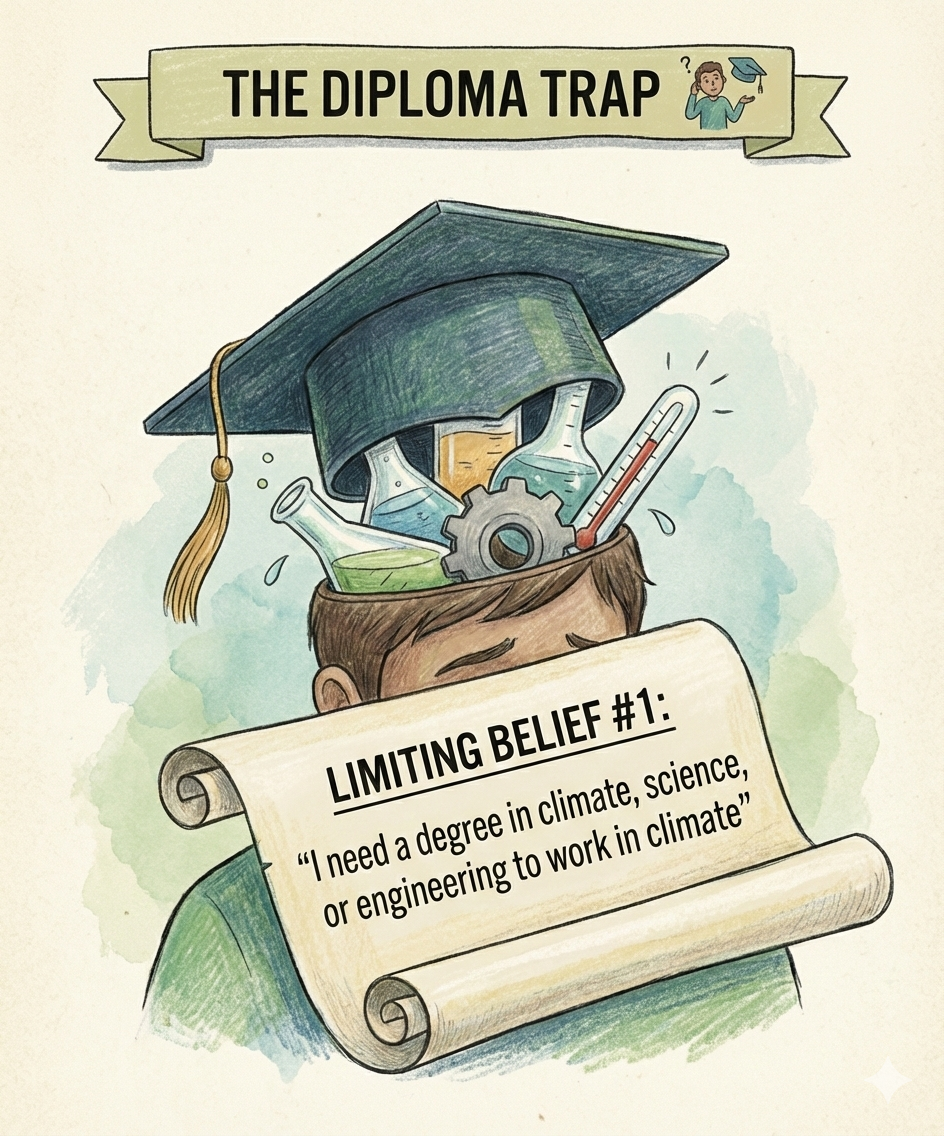
Reveal: I like to call this limiting belief “The Diploma Trap”
Observe how the belief helps and hurts you:
Helps: this belief gives you a convenient reason to avoid trying to work in climate, because if you really need a post-graduate degree to work in climate and that’s not an option for you, then it’s ok to stop.
Hurts: You never start building climate fluency because getting to Master’s / PhD level expertise is an insurmountable thing to do on your own or at night after work.
Outline evidence for & against:
Evidence for: advanced degrees are required for some climate engineering, scientist, and research roles.
Evidence against: Below are just a few real clients who landed climate jobs without a climate degree (names anonymized):
James: Program Manager with a B.A. English who transitioned into a Director role at a commercial electrification startup
Lily: Non-Profit VP with a Master’s in Library & Information Science who transitioned to a Director of Development role at an environmental nonprofit
Transform it into a truer belief:
I don't need a climate degree. I need climate fluency (enough to speak the language, understand the problems, and know where I fit). Those aren't the same thing.
Strengthen your belief with 1 small, aligned action:
Find 2-3 people in OpenDoorClimate’s directory of people that made the transition to climate work without a climate-related degree and send them a connection request
Find one job posting you’re genuinely excited about and save it without filtering yourself out because you worry you don’t have the right degree
Limiting belief #2: “My past experience isn’t transferrable to climate work”
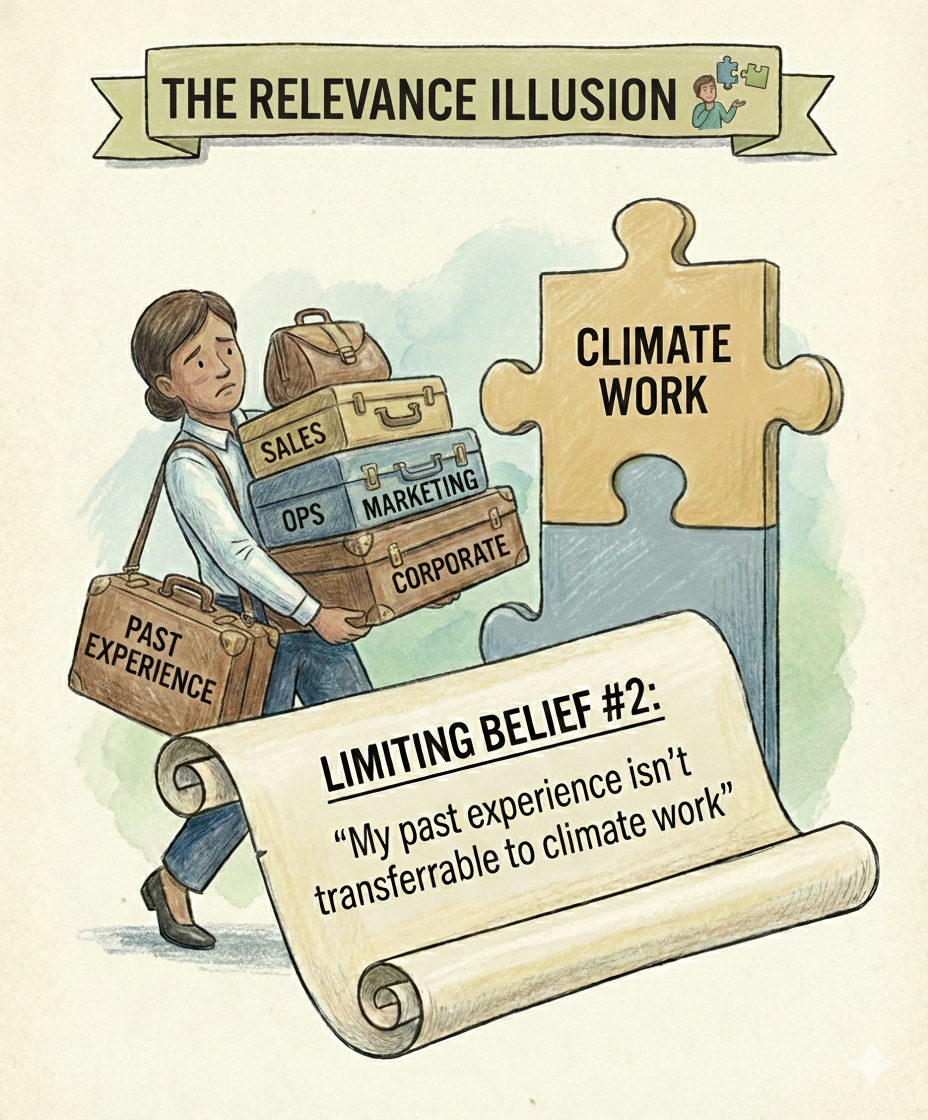
Reveal: I call this one “The Relevance Illusion.” It’s the mistaken idea that unless your resume already says "climate," your experience doesn't count and you’re starting from zero.
Observe how the belief helps and hurts you:
Helps: It protects you from the vulnerability of trying. If your experience genuinely doesn't transfer, then not getting hired isn't a reflection of your abilities, it's just a mismatch. The belief keeps you safe from that test.
Hurts: You never do the translation work that would actually make your experience relevant in climate. You either don't apply to roles you're genuinely qualified for, or you apply with generic materials that don't connect your background to climate problems. When the rejection comes, it confirms the belief.
Outline evidence for & against:
Evidence for: Some highly specialized climate roles (climate modeling, carbon accounting, policy research) favor candidates with direct climate experience or domain-specific knowledge.
Evidence against: My analysis of 16,000 climate jobs on Climatetechlist in May 2025 found that over 10,000 open climate roles were non-engineering positions spanning sales, operations, design, marketing, and analytics. The skills gap isn't between your background and climate. It's between your background and your climate pitch.
Transform it into a truer belief:
My experience isn't irrelevant, but it is untranslated. Climate organizations need exactly what I do. I just need to connect my skills to the problems they're trying to solve.
Strengthen your belief with 1 small, aligned action:
Go to Climatebase or greenjobsboard and find 3 open roles in a climate sector you're curious about. For each one, write down one thing from your background that directly connects to what they're asking for to collect evidence that you have relevant skills that do translate to climate work.
Limiting belief #3: "I can't compete in this tough climate job market”
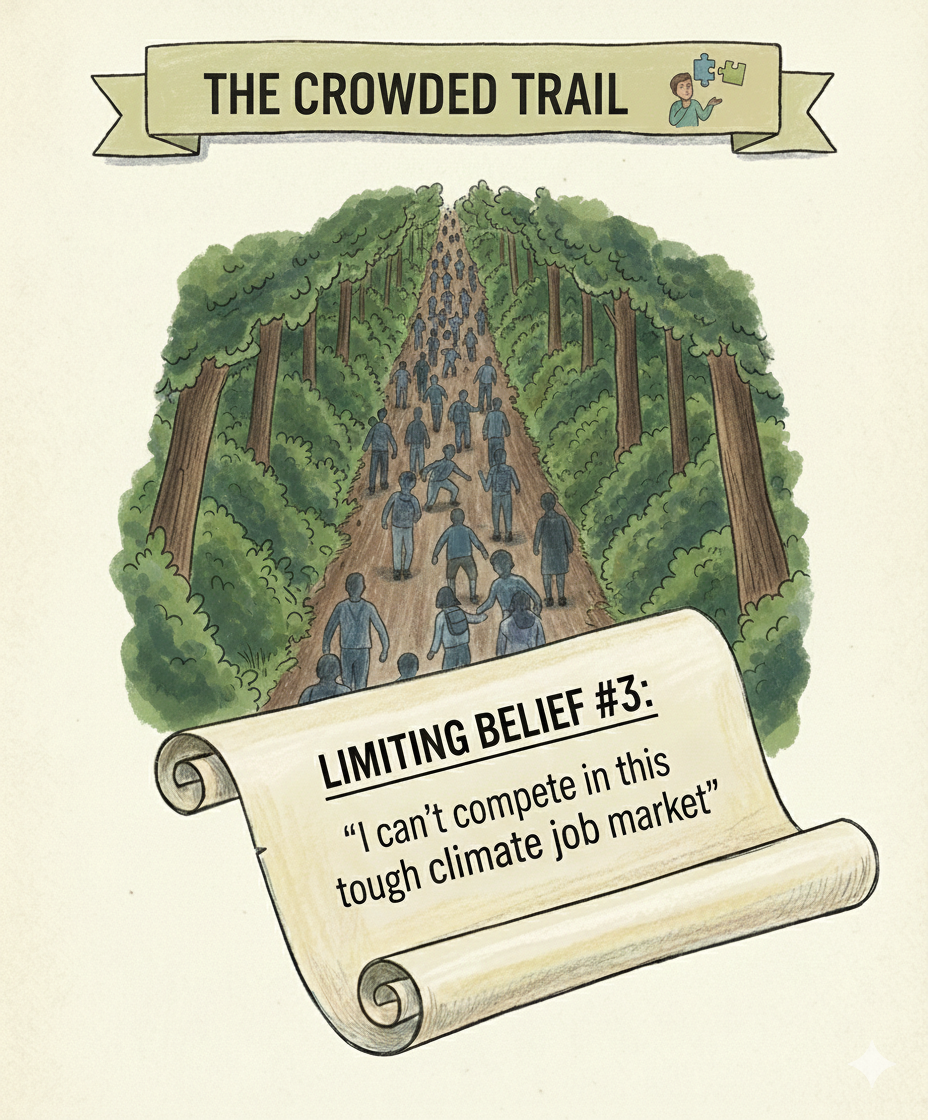
Reveal: I call this one “The Crowded Trail” because it feels like the path to a climate job is so packed with more qualified candidates that there's no point in even lacing up your boots and trying.
Observe how the belief helps and hurts you:
Helps: It makes inaction feel responsible rather than fearful. "I'm being realistic about the market" sounds smarter and more mature than "I'm scared." The belief disguises fear as a wise decision.
Hurts: It keeps you from doing the things that actually make you more competitive. Building a proof project, going deep on one niche, or doing targeted outreach feel pointless if the market is rigged, so you don't do them. And then you actually can't compete, not because the market is impossible but because you never built the advantage.
Outline evidence for & against:
Evidence for: The climate job market is harder than it was in 2021 - 2023. Climate VC funding has cooled, and government policy has shifted. Layoffs in tech, climate tech, and the public sector have pushed more qualified candidates into the market. Some climate companies are in hiring freezes or scaling back. This is unfortunately the honest backdrop.
Evidence against: Most candidates competing in this market are doing it wrong. They're applying broadly with generic materials, no clear focus, and no proof of their climate thinking. While the market is crowded, it’s easy to do something different by being more focused, better positioned, and demonstrating value. A different job search approach can yield different results, despite the competition.
Transform it into a truer belief:
The market is tough, but most applicants are doing it wrong. I'm competing differently.
Strengthen your belief with 1 small, aligned action:
Write down the last 3 times you were hired or chosen for something competitive, like a job, project, promotion, or award. The belief says you can't compete. Your own history probably says otherwise.
Ask one person who knows your work well (a former manager, colleague, or collaborator) what they'd say if someone asked why you'd be good at your target climate role. Truly listen to it, internalize it, and write down their answer verbatim.
Now it’s your turn
Don’t just read this article! Now’s your time to apply it:
Which of these three common limiting beliefs feels most true for you right now?
Apply the ROOTS framework to that limiting belief on paper
Identify one small action that would test your new belief this week.
Want to go deeper?
This article covered 3 of the most common beliefs I see in climate job searches. The free, ROOTS worksheet I made covers 2 more, including:
“It’s too late for climate action. We’re screwed anyway.”
“I’m not good at networking, so I can’t make this transition”
It also includes:
Actionable summary of the ROOTS framework
A blank, step-by-step ROOTS template to identify and work on your own limiting beliefs
Pre-filled examples for five of the most common limiting beliefs in climate
AI prompts to help you stress-test and strengthen each step in the ROOTS framework
If you’re serious about making the transition, don’t just read about ROOTS, use it.
Frequently Asked Questions
What if I've tried reframing and it didn't work?
You may have chosen and reframed a belief that isn’t the one really holding you back. Or, you need help translating your experience and building proof that you do belong in the climate space to offset the evidence from past rejections.
How long does it take to shift a limiting belief?
It depends on how long you've had the belief and how much evidence you've already accumulated. Some people can make the shift after one good conversation. Some take months of repetition. The goal is to make progress, not to transform overnight.
What if multiple beliefs are holding me back at once?
Work on the one causing the most damage to your search. Don't try to fix everything at once.
Is this therapy?
No, and it's not meant to replace it. If you find that exploring these beliefs surfaces something deeper (grief, anxiety, depression), get support from a mental health professional.
What if I genuinely don't have transferable skills?
You do. What you don't have yet is the translation and proof of climate relevance. That's what the Story and Signal steps of the A.S.S.E.T™ Method is for. Subscribe to Climatefarer to get notified with the Story and Signal deep dive articles are published.
Want more help?
If you’ve read this and thought, “I understand this… but I still feel stuck,” that’s not a motivation problem. It’s usually one of two things:
The belief you’re fighting isn’t the real one holding you back
You need help identifying or building the climate-relevant evidence to shift your belief.
That’s where coaching changes the story you’re telling yourself. In our first session, we’ll:
Identify the belief that’s actually running (or derailing) your search
Trace exactly how it’s shaping how you focus, apply, network (or not), and show up
Replace it with a belief grounded in evidence
Leave with one strategic move that aligns with the new belief you’ve crafted
You won’t leave with inspiration. You’ll leave with clarity and a plan you believe in. If you’re ready for that: